
The plates have been cleared.
There is half a glass of wine left on the table. The conversation is still warm. A guest reaches for their phone, che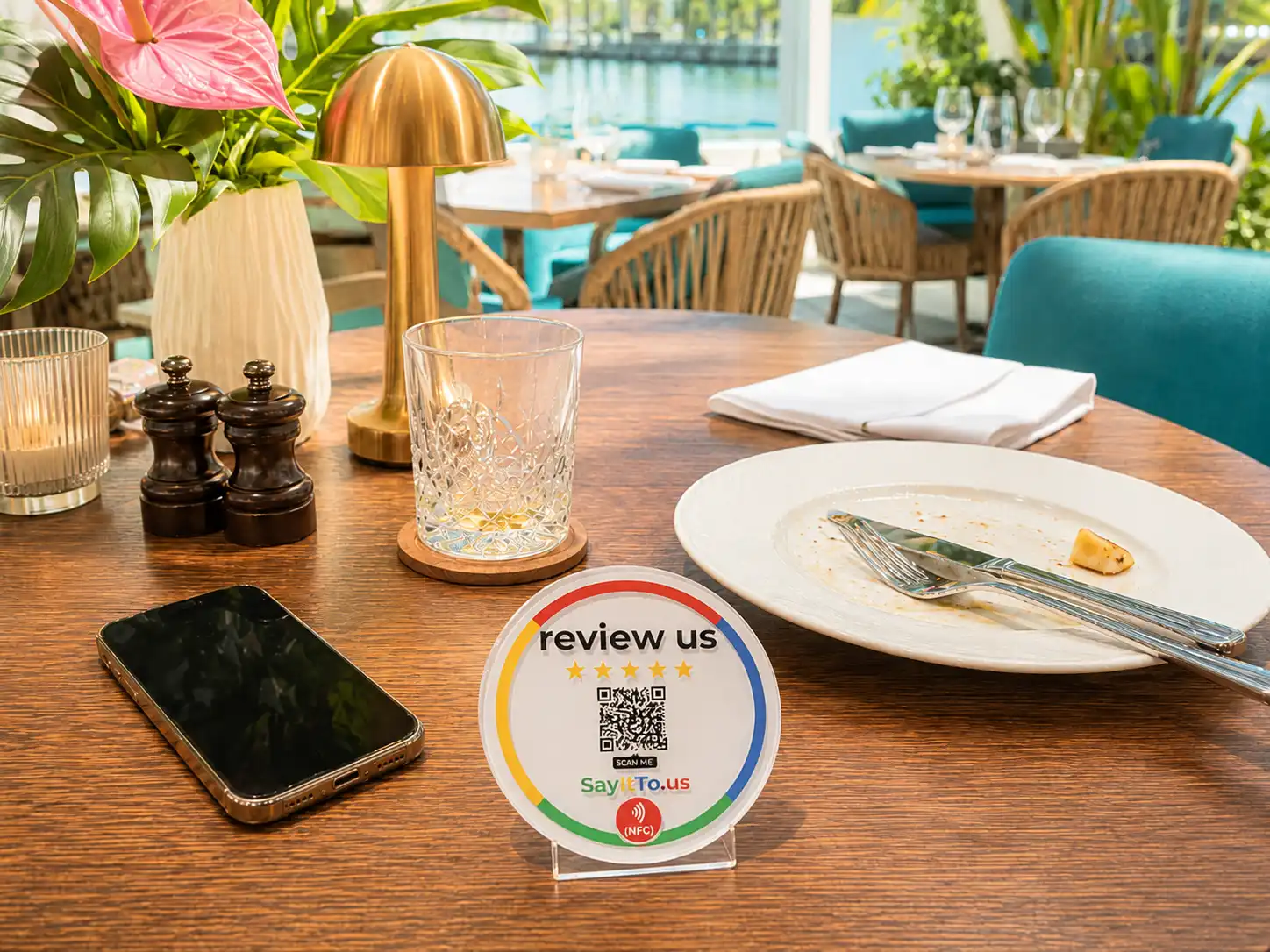
cks the time, and prepares to leave.
They had a wonderful evening.
Tomorrow, they may tell a friend about it. Next week, they may return. But that small, valuable moment—the moment when their satisfaction is still fresh—is about to disappear through the front door with them.
This is where many venues lose reviews.
Not because their customers are unhappy.
Because leaving a review requires one more thought, one more search, and one more task to remember later.
Make the honest action easier.
Google itself allows businesses to invite customers to leave reviews. It even provides review links and QR codes that businesses can place on receipts, in emails, at the end of a chat or inside the venue. :contentReference[oaicite:2]{index=2}
The goal is not to manufacture praise.
It is to remove the unnecessary steps standing between a genuine experience and an honest review.
A customer should not have to:
- Search for your business
- Wonder whether they found the correct location
- Open several pages
- Remember your request the following morning
One scan or tap can take them to the right place while the experience is still alive.
What is review gating?
Review gating occurs when a business first asks customers how they feel and then treats them differently based on their answer.
A happy customer may be sent to Google.
An unhappy customer may be diverted to a private form and never shown the same public review option.
It can feel like a clever shortcut. The business still receives private criticism, while Google appears to have mostly happy customers.
But the resulting picture is no longer completely honest.
Google’s Maps policy specifically prohibits merchants from discouraging negative reviews or selectively soliciting positive ones. It also prohibits incentives and pressure intended to influence a review’s rating or content. Genuine review invitations are allowed, provided the business does not attempt to control the result. :contentReference[oaicite:3]{index=3}
Honesty is also becoming a regulatory expectation.
The United States and Europe do not use exactly the same rules as Google, but the direction is clear: reviews should reflect real experiences.
The FTC’s Consumer Reviews and Testimonials Rule took effect in October 2024. Among other practices, it prohibits incentives that are expressly or implicitly conditional on a review expressing a particular sentiment. The FTC also addresses fake reviews and certain forms of review suppression. :contentReference[oaicite:4]{index=4}
EU rules require traders displaying consumer reviews to disclose whether and how they verify that those reviews are from real consumers. They also prohibit buying fake reviews and altering customer reviews or ratings. :contentReference[oaicite:5]{index=5}
The safest long-term strategy is not to become better at manipulating appearances.
It is to become better at inviting truth.
A better review process
An honest review journey is surprisingly simple.
Invite every customer equally.
The same QR code, NFC tap, or review invitation should be available regardless of whether the customer appears delighted, neutral, or disappointed.
Ask at a natural moment.
A thoughtful invitation after a meal, completed service, hotel checkout, or successful appointment feels very different from pressure.
The words can be as simple as:
“Thank you for visiting us. Your honest experience can help another customer—and it helps us become better too.”
Remove unnecessary friction
Link directly to the correct Google Business Profile. Do not make customers search for the venue or choose between several locations.
Do not prescribe the answer.
Avoid asking for “five stars,” suggesting specific wording, or rewarding customers for positive sentiment.
Ask for honesty, not applause.
Listen privately without blocking the public route.
A venue can—and should—provide a direct feedback channel for customers who want to speak with management.
The important distinction is that private feedback should be an additional door, not a hidden corridor used to prevent certain customers from seeing the public one.
What about a negative review?
A negative review can hurt. For a caring owner, it can also feel deeply personal.
But it may reveal a forgotten table, an unclear service charge, an exhausted employee, or a small operational problem quietly affecting many guests.
Google recommends responding to reviews because a thoughtful response shows customers that their feedback matters. :contentReference[oaicite:6]{index=6}
The goal is not to create the illusion that nothing ever goes wrong.
It is to show what happens when something does.
A sincere response, a corrected mistake, and a better next visit can sometimes tell a more powerful story than another anonymous five-star rating.
The review request you can be proud of
OuiReview was designed around one uncomplicated principle:
Every genuine customer deserves the same honest invitation.
One scan. One tap. No filtering. No prizes for stars. No uncomfortable pressure at the counter.
Just a shorter path between a real experience and the person willing to share it.
Because a reputation built honestly may grow more gradually—but it stands on much stronger ground.
VISUAL SUGGESTIONS
- Hero photograph: the quiet end of a restaurant meal, with a phone beside an almost-finished glass and a small review QR card.
- Simple comparison graphic: “Review gating” versus “One honest invitation for everyone.”
- Three-icon policy strip: No filtering · No incentives · No pressure.
- Short animation showing a receipt QR code opening the correct Google review page.
- Founder callout featuring Mickaël’s line: “Ask for honesty, not applause.”
PRIMARY CTA
Invite every customer honestly.
Turn the moment after a great experience into a genuine Google review—with one simple scan or tap.
Explore OuiReview →